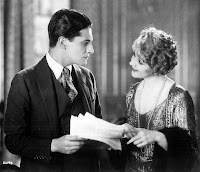
 Retitled When Boys Leave Home upon release in the U.S., Downhill was the second and last teaming of star Ivor Novello and director Alfred Hitchcock. Credited with a nom de plume, Ivor Novello co-wrote the script with actress Constance Collier; she would later appear in Hitchcock's Rope in 1948. It's a misogynistic tale of a wealthy young man led by unscrupulous women to his downfall, hence the title. First he is kicked out of school because a young tart accuses him of either raping or impregnating her; second a young actress he works with on the stage takes him to the cleaner; lastly, a predatory older woman uses him as a gigolo.
Star Novello is ravishing to look at - so handsome! He is shown with his shirt off in one scene! He was gay in real life! Best known for writing and acting in musicals on the London stage, he penned the WWI classic "Keep the Home Fires Burning", and "hung" out with Noel Coward and Laurence Olivier. His film career lasted until the mid-1930's and he passed away at age fifty-eight in 1951; coronary thrombosis.
The gold-digging stage actress is played with vivaciousness by a Carey Mulliganesque Isabel Jeans. Hitchcock was evidently impressed with her for they worked together after Downhill on Easy Virtue. She appeared in Suspicion fifteen years later in a supporting role.
Along with the performances, Hitchcock's inventive camera work raises Downhill above the mediocre level. The last reel features an effective hallucination scene with characters fading in-and-out of focus from the POV of Novello's character.
The movie can be streamed here via Internet Archive.
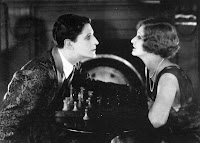 Film-making in England in the nineteen-twenties was a distant third in terms of craftsmanship in the world; behind the U.S. and Germany and, yes,Sweden. Alfred Hitchcock's artistry lent the fledgling Brit movie business luster and cred and he made his first true suspense thriller as a director with this acclaimed silent produced in 1926. The suspense in this movie comes from what is implied rather than shown. The audience never sees the actual murderer just the calling cards he places on his victims. Ultimately The Lodger is about mistaken identity. Not murder. The Jack the Ripper murderer never shown is just Hitchcock's McGuffin: a plot point to move the story along.
With silent pictures the directors had to tell a story with images and that's why silent movies are so much more expressive and poetic than talking movies. That poetry was lost when sound came in 1927 with The Jazz Singer; the exact year this movie was released. Not surprisingly visuals are amazing in this movie; it opens with a murder, not shown but implied by a woman screaming, then a montage of police, spectators, print presses running, and then newsboys screaming the headlines. All expertly edited by Ivor Montagu. The technical tricks are what give the move weight; alas, this story has been done innumerable times.
And, of course, being a Hitchcock movie it's all about the women. Hitchcock agreed with Sardou that the women in their work "should suffer." In this particular movie the leading lady, June, doesn't suffer much, but she does have her own title cards and any scene she's in the camera highlights her; it's like there's a halo around her. June's costumes: the b&w ensemble at the end ensures she sticks out among st the brown and grays the other characters are wearing during the lynching scene. Evidence that Hitchcock wanted all eyes on her character whenever she's in a scene.
Hitchcock made June wear a blonde wig for the shoot, so his obsession with blondes was there in the beginning. He favored the fair-haired women as his work from here on out details; it wasn't something he developed over time, even though he wasn't always allowed to use these hair color types he desired. Even the murderer in the movie prefers fair haired curly-haired females.
Billed just as June, the actress June Howard-Tripp was mainly a performer in light musical comedies and revues on the stage. She only made a handful of movies; the best known of which is The Lodger. A picture of her becoming a U.S. citizen can be seen here.
The charismatic leading man, songwriter/performer Ivor Novello, was gay in real life. Originally, Hitchcock wanted the character of the Lodger to be more sinister, leading the audience to suspect that he actually was the murderer, but the studio producing the movie, Gainsborough Pictures, were worried that Novello's huge female fan base would be upset. Famously, Novello is introduced in the picture by having his shadow shown on the door of the boarding house as he approaches. In a master shot, the lady of the house opens the door and he is shown, eerily, shrouded in shadow and fog. It's the best shot in the movie.
Novello starred in a remake of The Lodger in 1932.
Also noteworthy: the mob scene at the end when Novello, hanging by a pair handcuffs, becomes entangled on an iron fence while women and men beat him. And I love the loose, frilly twenties dresses June wears.
"The Lodger" is included in a DVD package I own with 20 of Hitchcock's early British movies.
 Retitled When Boys Leave Home upon release in the U.S., Downhill was the second and last teaming of star Ivor Novello and director Alfred Hitchcock. Credited with a nom de plume, Ivor Novello co-wrote the script with actress Constance Collier; she would later appear in Hitchcock's Rope in 1948. It's a misogynistic tale of a wealthy young man led by unscrupulous women to his downfall, hence the title. First he is kicked out of school because a young tart accuses him of either raping or impregnating her; second a young actress he works with on the stage takes him to the cleaner; lastly, a predatory older woman uses him as a gigolo.

